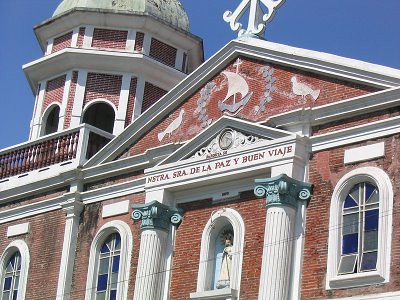
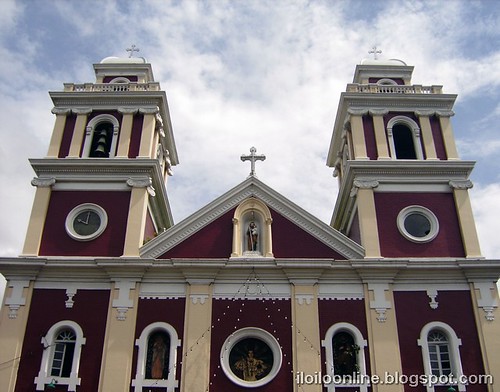
 The feminist church of Molo was built in 1831. It was built not only as a house of worship but as a monument of Ilonggo artistry in the world of Classic architecture . The overall design is Gothic Reniassance minus the flying butresses and the gargoyles. The interior is a fusion of Gothic and Romanesque architectures, there is a constant alternation between the overpowering features of Gothic and the recessive characteristics of Romanesque.
The Spires of Molo are yet the most interesting colonial skyscrapers in Iloilo City aside from the Neoclassic Belfry of Jaro. Images of 16 Female saints can be found inside, hence the church gained the title 'Women's Church'. Historty says that when Joze Rizal visited Iloilo, he adored the church becuase of its beautiful biblical paintings.
 Photos by: Explore Iloilo


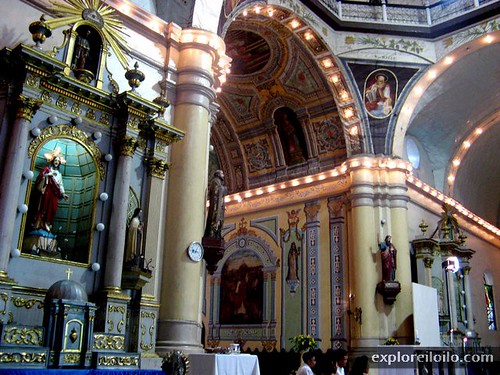 The retablos located in the transepts are of Baroque architecture. The curvilinear movement brought by the bright colors and the wavy outlines of some religious ornaments suggest a baroque feel.The original belfry of the church is a grand example of Neoclassic architecture. This is one of the few belfries in the Philippines which are separated from their root churches. The belfry was formerly ruined, consequently, it was restored to its former grandeur except for the statuaries which once crown the first level of the tower.